

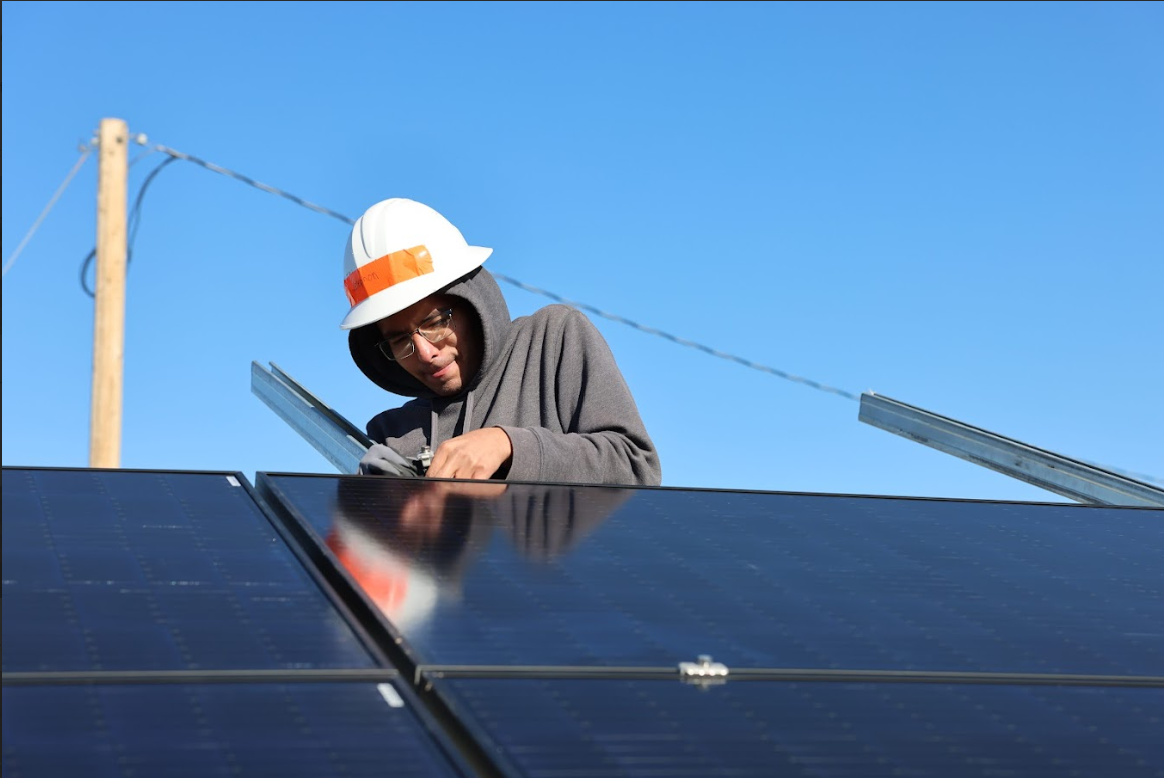
When most people think about solar energy work, they picture panels going up under blue skies, crews on rooftops, and systems coming online during the warmer months. What often isn’t seen is the season that makes all of that possible.
At Indigenized Energy, winter is not a time to pause. It is all about preparation.
While snow covers the Plains and physical construction slows, our team is working at full speed behind the scenes, laying the groundwork for the projects, partnerships, and progress that will come in spring, summer, and fall.
Winter is peak season for fundraising and foundation work. Grant deadlines stack up, research intensifies, and applications require deep coordination across teams.
Our foundations and fundraising work during the winter focuses on securing the resources that allow Tribal communities to move forward with energy projects on their own terms.
“Winter is when we’re translating community needs into funding strategies,” says Cody Two Bears, CEO of Indigenized Energy. “Every application represents real homes, real families, and real infrastructure. The work is detailed and demanding, but it’s what makes our field projects possible.”
This work includes researching new funding opportunities, strengthening relationships with philanthropic partners, and aligning grant proposals with Tribal priorities and project timelines.
For Tribal Relations, winter is a season of listening, planning, and trust-building.
Our team meets with Tribal leaders, housing authorities, utilities, and community partners to understand evolving needs, evaluate readiness, and collaboratively plan what comes next.
“Winter is when we slow down enough to plan purposefully,” says Shelby Keplin, Tribal Relations Director. “We’re not just planning projects, we’re building relationships. That means honoring Tribal processes, taking the time to listen and answer questions, and ensuring each step aligns with Tribal priorities and community readiness. Our role is to walk alongside Tribes, not rush them, and make sure the next step truly makes sense for the people it will serve.”
These conversations shape everything from project scope and location to workforce involvement and long-term sustainability. By the time spring arrives, projects are not just shovel-ready, they are community-ready.
While installations may pause, Field Operations stays active all winter long.
This includes coordinating with contractors, finalizing system designs, sourcing donated or discounted materials, and mapping out complex logistics for remote and rural builds. The team also stays in close contact with communities where systems are already installed.
“We’re constantly checking in on our existing systems throughout the winter. Monitoring performance, troubleshooting issues, and ensuring efficient operation,” says Kevin Arocho, who leads Technical Operations. “We also provide training so communities can maintain their own systems and build energy sovereignty. At the same time, we’re preparing for the build season by securing licensed local contractors, sourcing donated materials, and coordinating logistics so projects can launch immediately once conditions permit.”
Winter preparation ensures that once crews mobilize, delays are minimized and communities see progress without unnecessary setbacks.
The reality is simple: there is no build season without winter preparation.
Every solar installation, battery system, and energy resilience project completed in warmer months is the result of months of planning, coordination, fundraising, and relationship-building that happens long before the first panel is installed.
Winter is when Indigenized Energy turns vision into plans, and plans into action.
It is when we ensure that projects are well-funded, community-driven, and technically sound. It is when we strengthen partnerships and prepare to deliver real, lasting impact across Indian Country.
When spring arrives and work moves back into the field, it is not a beginning, it is the continuation of work that never stopped.