

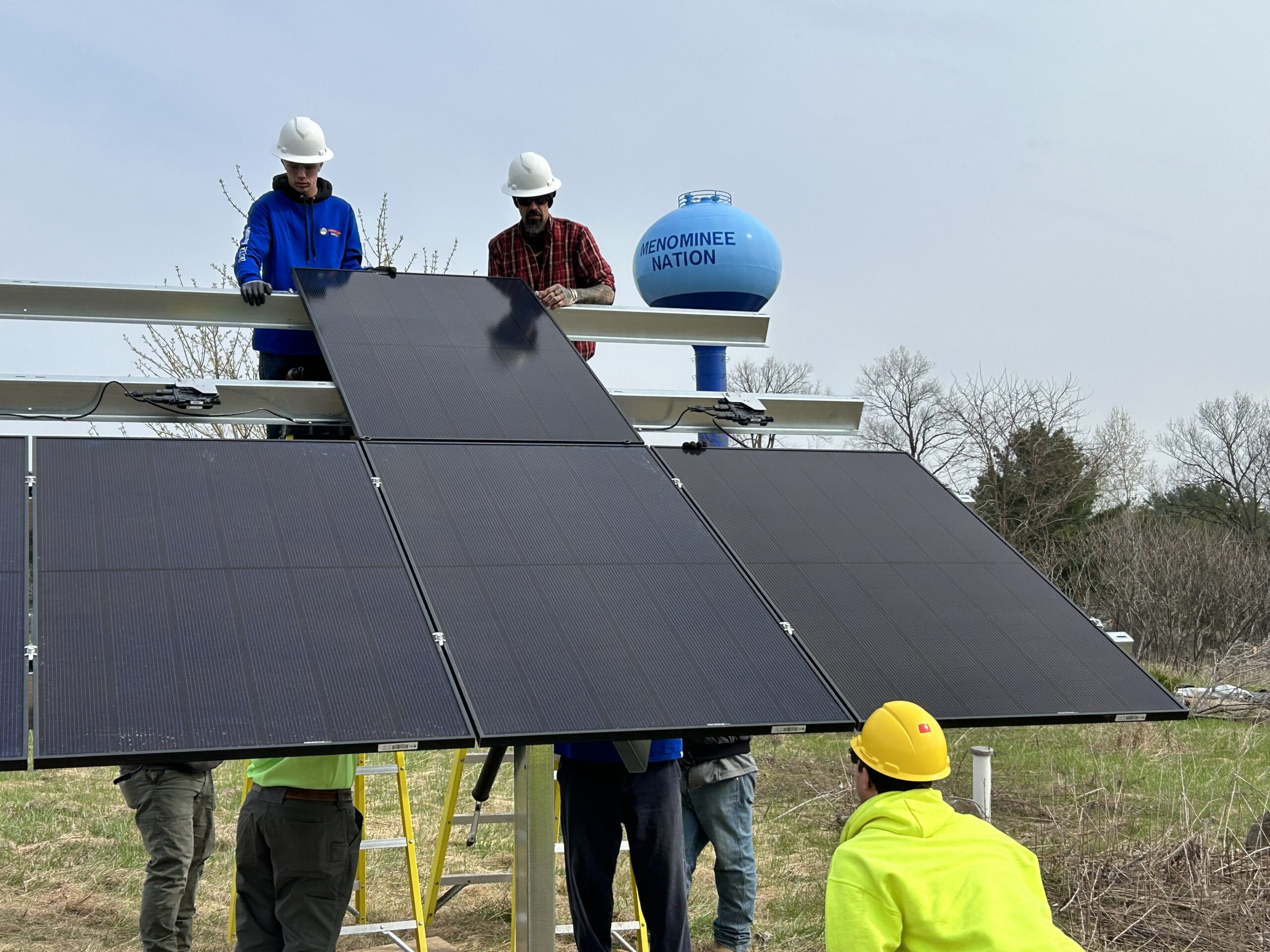
When the Menominee Tribe of northern Wisconsin began exploring residential solar, the goal was not simply to install new technology. In a region known for its dense forests, towering trees, and long, unforgiving winters, the Tribe wanted to understand how clean energy could strengthen households, build long-term capacity, and serve those most vulnerable to power disruptions.
Indigenized Energy first entered the conversation at the invitation of then Tribal Chairman Ron Corn. Rather than arriving with a predefined plan, the IE team traveled to Menominee to listen and learn and to better understand the Tribe’s priorities, infrastructure, and long-term vision for energy sovereignty.
At the time Indigenized Energy was invited into the conversation, the Menominee Tribe had secured federal funding through the American Recovery and Reinvestment Act (ARRA). Leadership made the deliberate decision to allocate $1 million specifically toward renewable energy planning and early implementation. It was not a high-profile or immediate return investment, but it was a strategic one, focused on building long-term capacity rather than short-term visibility.
With the commitment from leadership as a foundation, Indigenized Energy helped the Tribe think through a strategic approach. Recommendations included investing in a solar project at the Tribal College, hiring staff to support long-term energy planning and implementation, and launching a residential solar and battery storage pilot program focused on households most at risk on the grid.
That residential pilot became a key early step.
The program ultimately served five Elder households, many of which are multigenerational. These homes are often located in more remote areas, where power outages can be especially dangerous and access to emergency services during severe weather is limited. Prioritizing these households was both a practical and values-driven decision, ensuring reliability, safety, and stability for families who face the greatest risk when the grid fails.
From the outset, this work was not simple. Together, the Tribe and Indigenized Energy navigated logistical hurdles, internal processes, and the realities of launching something new within a complex system. Some challenges were expected, others were not, but all were part of building a path the Tribe could replicate in the future. Indigenized Energy walked alongside the Tribe through each step, knowing that early challenges would help smooth the way for future projects and additional families.
Through the pilot, solar and battery systems were installed to provide locally generated, reliable power. For participating households, this meant protection during outages, relief from high and unpredictable energy costs, and greater security through winter storms and extreme weather. In one instance, a participant shared that during a community-wide outage, they did not even realize the power was out. Their home stayed powered while everyone else was out.
Now more than a year after installation, and in the middle of the second winter, the systems continue to perform. They have endured real-world conditions and are delivering exactly what they were designed to provide: reliable energy, resilience, and peace of mind.
“The first projects are always the hardest. You’re building something new, learning the systems, and navigating challenges that only show up once you start, “ says Indigenized Energy CEO Cody Two Bears. “That’s why we try to do this work side-by-side with tribes. Once those lessons are learned, future projects become easier, faster, and more effective.”
This pilot program represents more than five completed installations. It reflects a model of collaboration where the Tribe did its part, Indigenized Energy did its part, and both remained committed through complexity. The relationship built through this process has proven just as important as the infrastructure itself.
This is what meaningful energy work looks like, not a one-time project, but a shared effort to build knowledge, confidence, and systems that can continue serving families long into the future. It is no longer a plan on paper. It is lived experience, and proof that this approach works.
Building on what was learned through the pilot program, this work is continuing. In Spring 2026, Indigenized Energy will again walk alongside the Menominee Tribe as they prepare to break ground on multiple new residential solar and battery storage systems. The upcoming projects reflect the Tribe’s commitment to applying lessons learned, continuing to invest in households most impacted by energy insecurity, and steadily expanding locally driven energy solutions.